
The first fossil of Iguanodon was a collection of teeth found by Marry Ann and Gideon Mantell in 1822, far before the term "dinosaur" was coined. Gideon Mantell thought the fossil belonged to a large, extinct species of iguana. That's why he named the newly discovered creature Iguanodon, or "iguana tooth."
Iguanodon walked on all four legs, but its back legs were larger than its front legs. The back legs ended in hoof-like three-toed feet. These strong back legs allowed Iguanodon to rear up and even walk on its back legs at times. The front legs were smaller and ended in a hand with five fingers. The middle three fingers ended in blunt claws and were close together to help support Iguanodon's weight when it walked on all fours. Its fifth or "pinky" finger had an extra bone in it that allowed the dinosaur to grasp onto vegetation. Its first finger or "thumb" was stiff and ended in a large spike. Paleontologists suggest this "thumb" was used as a defense against predators or to dig into fruits.
Iguanodon at the Akron Zoo
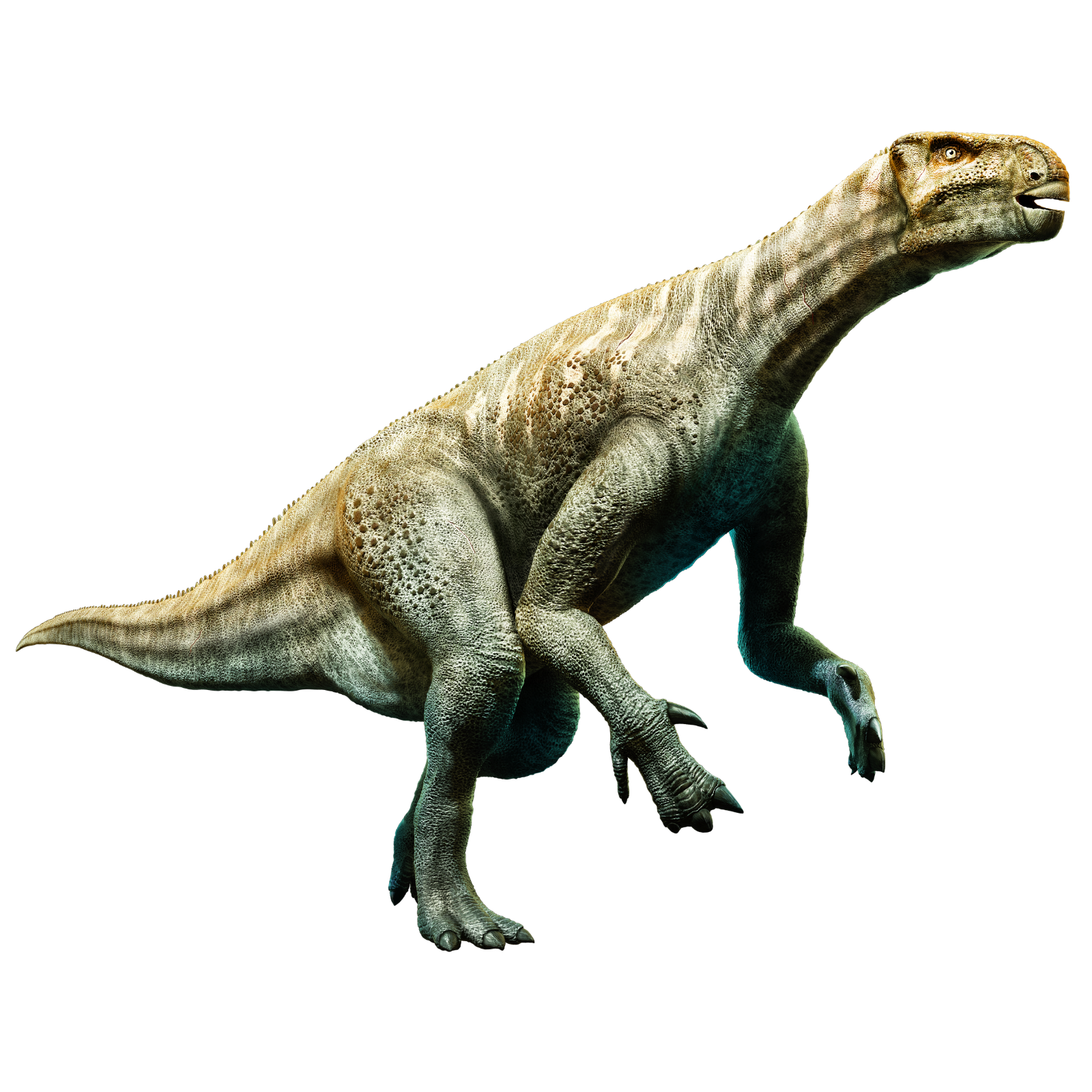
The Iguanodon is along the Pride of Africa train route.